Category: Events

  • CTAD 2026 recap: remote digital biomarkers and responsible data sharing

    CTAD 2026 recap: remote digital biomarkers and responsible data sharing

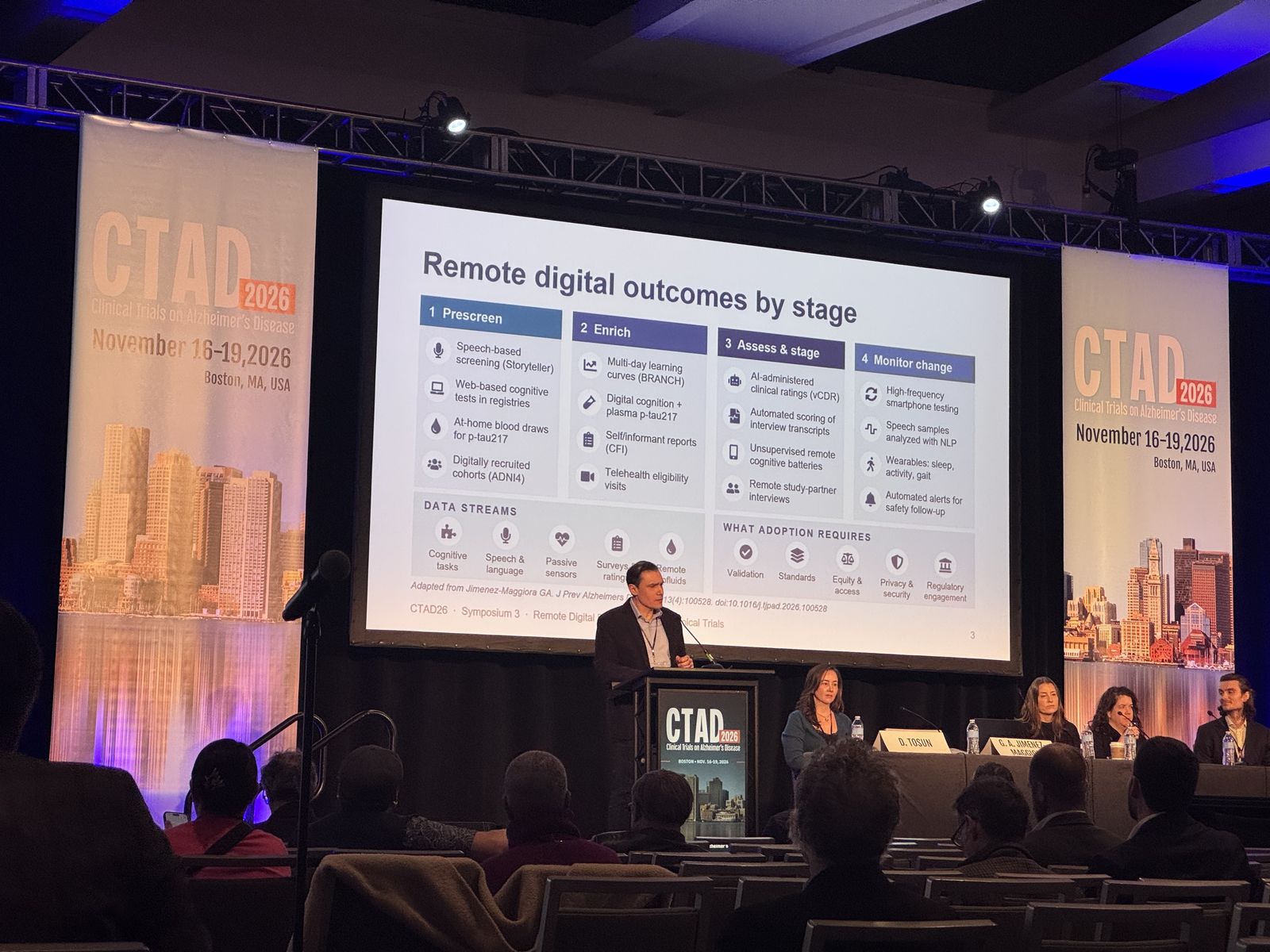
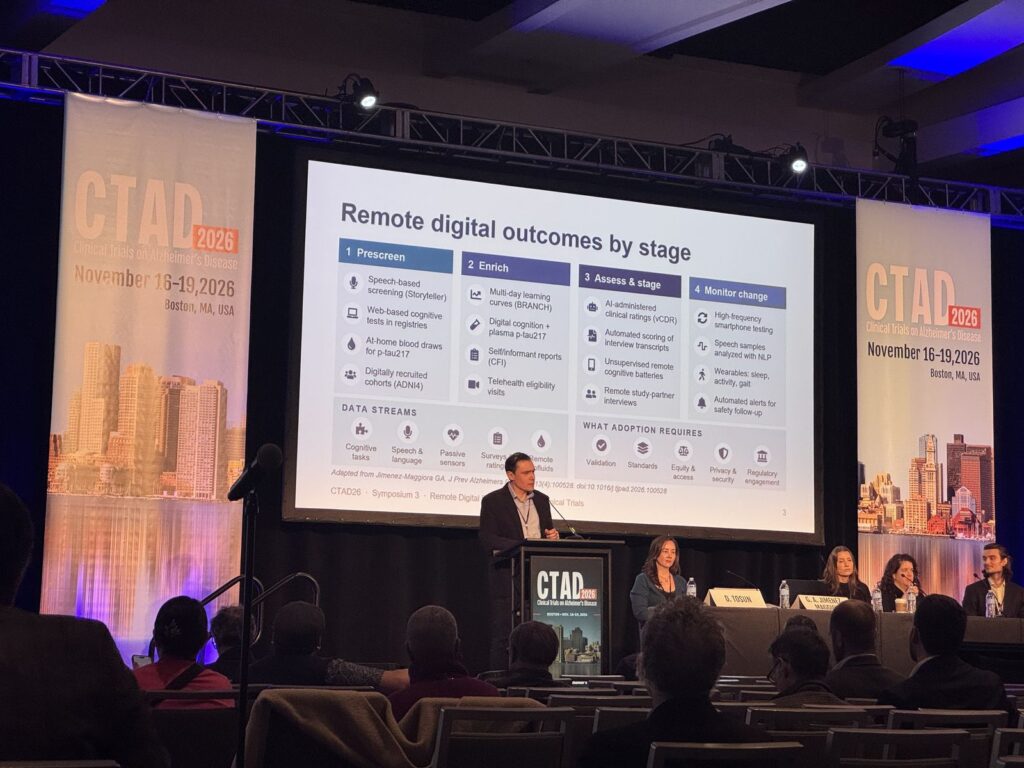
    Gustavo Jimenez-Maggiora at the podium in front of a slide titled Remote digital outcomes by stage, during CTAD 2026 Symposium 3 in Boston
    Gustavo Jimenez-Maggiora opens Symposium 3 with a framework for remote digital outcomes across prescreening, enrichment, assessment, and monitoring.

    At the 19th Clinical Trials on Alzheimer’s Disease (CTAD) conference in Boston, November 16–19, 2026, our section led two sessions. Gustavo A. Jimenez-Maggiora, PhD, MBA, co-chaired Symposium 3, Remote Digital Biomarkers in Alzheimer’s Disease Clinical Trials: From Scalable Prescreening to Sensitive AI-Enabled Assessment, with Duygu Tosun, PhD, of UC San Francisco on Tuesday, November 17. Richard Gallardo III presented poster P391, Responsible Data Sharing at Scale, on how ACTC shares trial data in public and limited tiers.

    Symposium 3: remote digital biomarkers
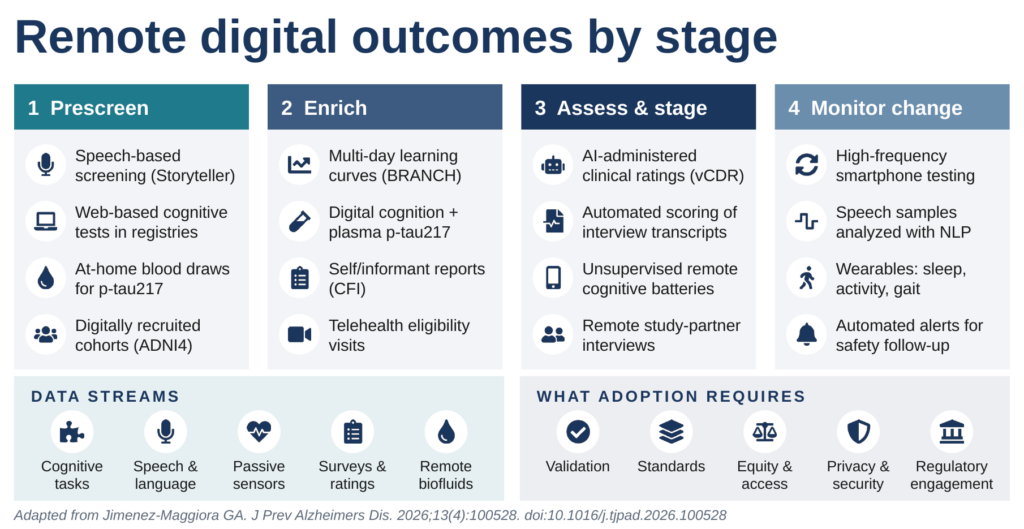
    Framework slide, Remote digital outcomes by stage. Four stages: 1 Prescreen (speech-based screening, web-based cognitive tests in registries, at-home blood draws for p-tau217, digitally recruited cohorts such as ADNI4); 2 Enrich (multi-day learning curves, digital cognition plus plasma p-tau217, self and informant reports, telehealth eligibility visits); 3 Assess and stage (AI-administered clinical ratings, automated scoring of interview transcripts, unsupervised remote cognitive batteries, remote study-partner interviews); 4 Monitor change (high-frequency smartphone testing, speech samples analyzed with NLP, wearables, automated safety alerts). Data streams: cognitive tasks, speech and language, passive sensors, surveys and ratings, remote biofluids. Adoption requires validation, standards, equity and access, privacy and security, and regulatory engagement.
    Remote digital outcomes by stage, from the symposium introduction. Adapted from Jimenez-Maggiora GA. J Prev Alzheimers Dis. 2026;13(4):100528.

    Dr. Jimenez-Maggiora opened the session with a framework for using remote digital outcomes at four stages of a trial: prescreening, enrichment, assessment and staging, and monitoring change. It is adapted from his 2026 paper in The Journal of Prevention of Alzheimer’s Disease, Remote outcome measures in Alzheimer’s disease clinical trials: A call to action. Three talks followed:

    • Rachel L. Nosheny, PhD (UCSF) · The voice CDR (vCDR), a generative-AI agent that administers and scores the Clinical Dementia Rating
    • Kathryn V. Papp, PhD (Brigham and Women’s Hospital / Massachusetts General Hospital, Harvard Medical School) · Digital multi-day learning curves for early detection of subtle decline in preclinical Alzheimer’s disease
    • Emil Fristed, MSc (Novoic) · Self-administered speech-based prescreening for MCI in the full ADNI4 digital cohort

    Dr. Tosun then led a moderated panel and audience Q&A.

    Poster P391: responsible data sharing at scale
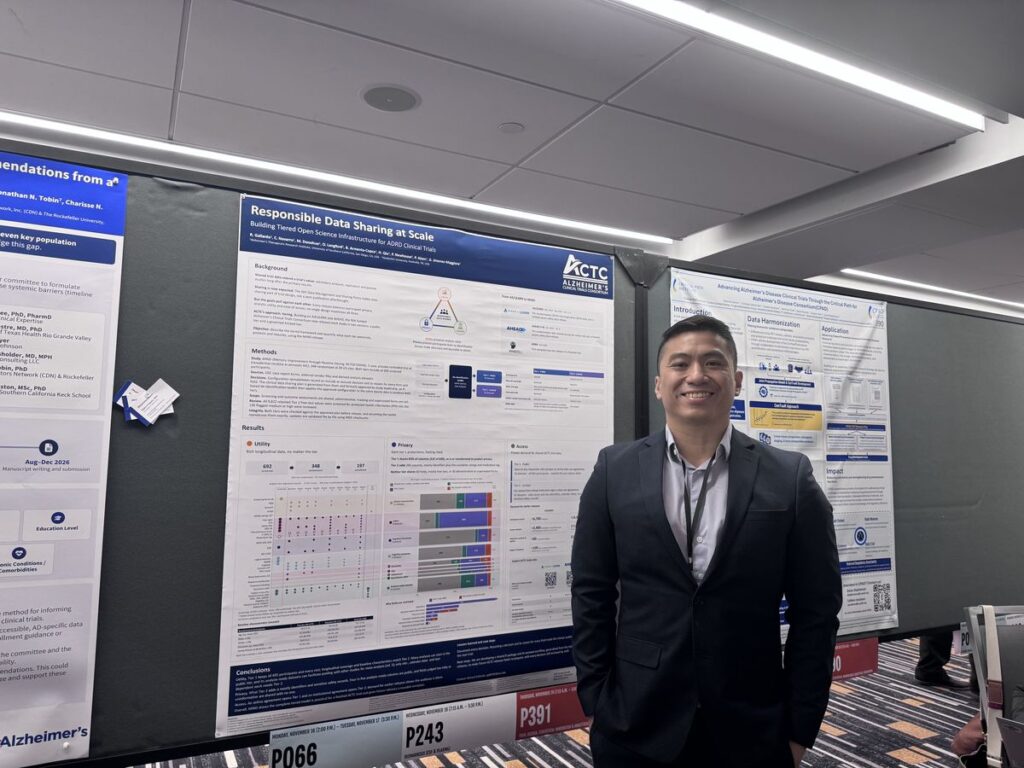
    Richard Gallardo III standing beside poster P391, Responsible Data Sharing at Scale
    Richard Gallardo III presents poster P391, Responsible Data Sharing at Scale.

    The poster describes how ACTC now shares each trial in two tiers: a public tier open to any researcher who accepts an online data use agreement, and a limited tier for researchers whose institution signs one. It uses the October 2026 release of MIND (Memory Improvement through Nicotine Dosing), the first complete two-tier release of a finished ACTC trial. The public tier keeps all 692 screened participants and every visit, and shares 65% of data columns (537 of 830) as is or transformed to protect privacy. Demand for earlier releases is strong: more than 2,400 investigators in over 60 countries and regions have requested A4/LEARN data.

    More from CTAD 2026

    Our team also contributed to six other CTAD abstracts, on plasma p-tau217 and amyloid PET, the AHEAD 3-45 and APEX screening cohorts, and remote cognitive assessment in registries and the APT Webstudy. See them on our Publications page.

  • Join us at CTAD 2026 in Boston

    The 19th Clinical Trials on Alzheimer’s Disease (CTAD) conference meets in Boston, November 16–19, 2026. Gustavo A. Jimenez-Maggiora, PhD, MBA, co-chairs the symposium Remote Digital Biomarkers in Alzheimer’s Disease Clinical Trials: From Scalable Prescreening to Sensitive AI-Enabled Assessment.

    Our team contributed to eight abstracts this year:

    • OC19 · Brain-derived pTau217 outperforms 328 plasma proteins for association with amyloid and tau accumulation and cognitive progression in the A4 and LEARN studies (November 18)
    • OC36 · Beyond amyloid and tau: hippocampal volume and cognitive performance in the AHEAD 3-45 screening cohort (November 18)
    • OC57 · Cross-platform performance of plasma p-tau217 assays for predicting amyloid PET positivity across cohorts (November 19)
    • OC58 · Plasma %p-tau217 and Aβ42/Aβ40 provide complementary information about amyloid PET below 20 Centiloids (November 19)
    • P375 · Leveraging anti-amyloid trial screening to establish a longitudinal primary prevention cohort: APEX recruitment and baseline findings
    • P391 · Responsible data sharing at scale: building tiered open science infrastructure for ADRD clinical trials
    • P434 · Performance on a multiday digital cognitive assessment in a large remote registry cohort
    • P502 · Baseline completion and retention with a new cognitive assessment in the APT Webstudy